

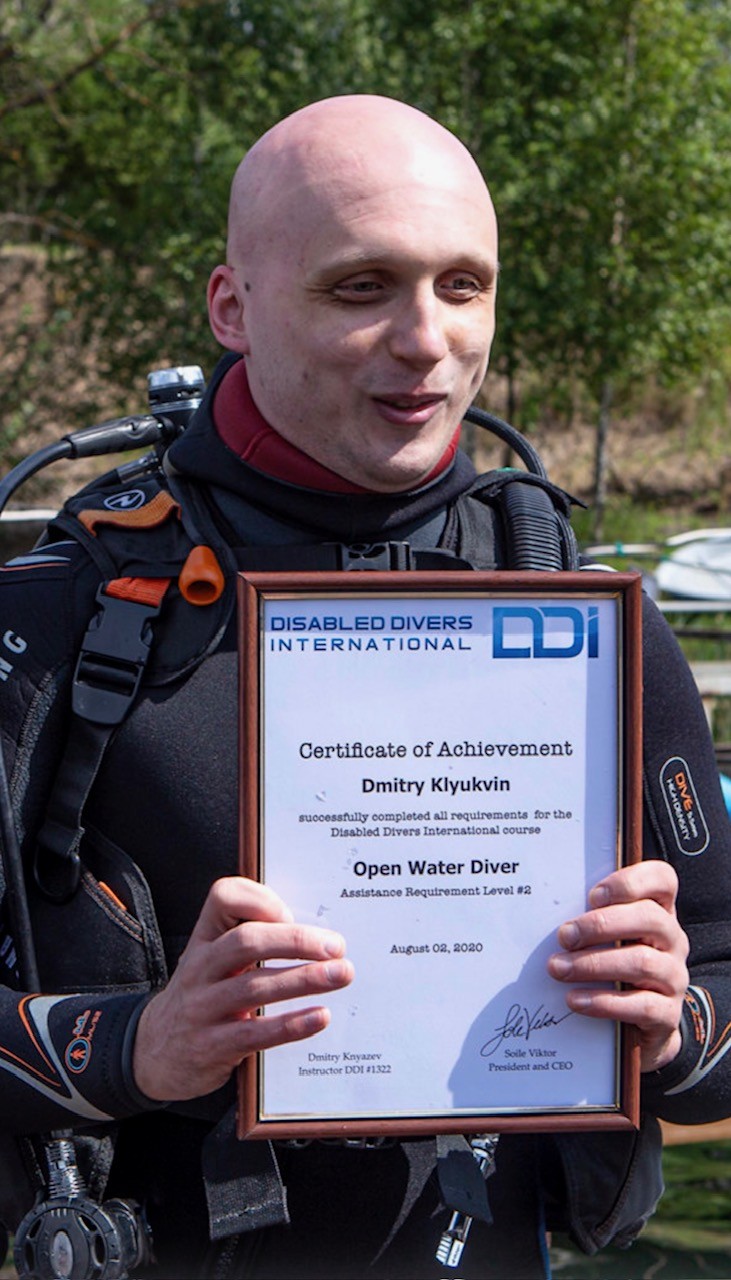
Most days, you’ll find Dmitrii Kliukvin at a sewing machine in BISM’s Sewing Department, where he’s worked as a Sewing Machine Operator for more than two years, making military jackets and other fabric products. What his coworkers may not know is that he’s also a record-setting athlete. Born blind, Dmitrii became Russia’s first blind certified open-water diver and set a national record with a 30-meter dive. Next summer, he plans to go after a Guinness World Record in blind diving.
Dmitrii has been an athlete for as long as he can remember, and he’s never waited for anyone’s permission to be one. When he got the chance to play blind soccer, he took it, and he kept taking it: four Russian national championships with the Moscow team, and the title of Master of Sports, one of the highest athletic ranks in the country. When he was done with soccer, he didn’t slow down. He moved on to sambo, a Russian martial art close to judo, then to diving. Somewhere in there, he also earned a master’s degree in Adaptive Physical Education and Rehabilitation.
Blindness never stopped him from doing any of it. Other people’s assumptions did. When he moved to the United States, he called company after company and couldn’t get hired. The championships, the master’s degree, none of it mattered more than the fact that he was blind. His first paycheck in this country came from donating blood.
Then, he was introduced to BISM. At BISM, being blind isn’t the thing an employer has to get past. Dmitrii joined our Sewing Department as a Sewing Machine Operator, making military jackets and other fabric products. It’s skilled, real production work done by blind people who were hired because they can do it.
BISM has also been in his corner off the production floor. When the head coach of the U.S. National Blind Soccer Team invited Dmitrii to pursue a spot on the roster, our CEO, Mike Gosse, wrote a letter endorsing him. For Dmitrii, playing for the U.S. would mean competing at the highest level again, in a new country, and showing what blind athletes can do when they get the chance.
Off the clock, he’s a full-time student, working to get his education recognized so he can be licensed in Maryland.
When asked what a blind athlete needs most, he says persistence and willpower. Plus, some luck.
“Many blind people are afraid to take the first step because there are many limiting factors,” he says. “People say that you won’t get anything done. Opportunities aren’t always available.”
His advice to other blind people is simple: don’t be afraid and start. He likes a Russian saying: If you’re afraid, don’t do it. If you do it, don’t be afraid.
“Don’t listen to those who try to restrict you and dissuade you,” he says. “Listen only to those who support you and go towards your goal.”