

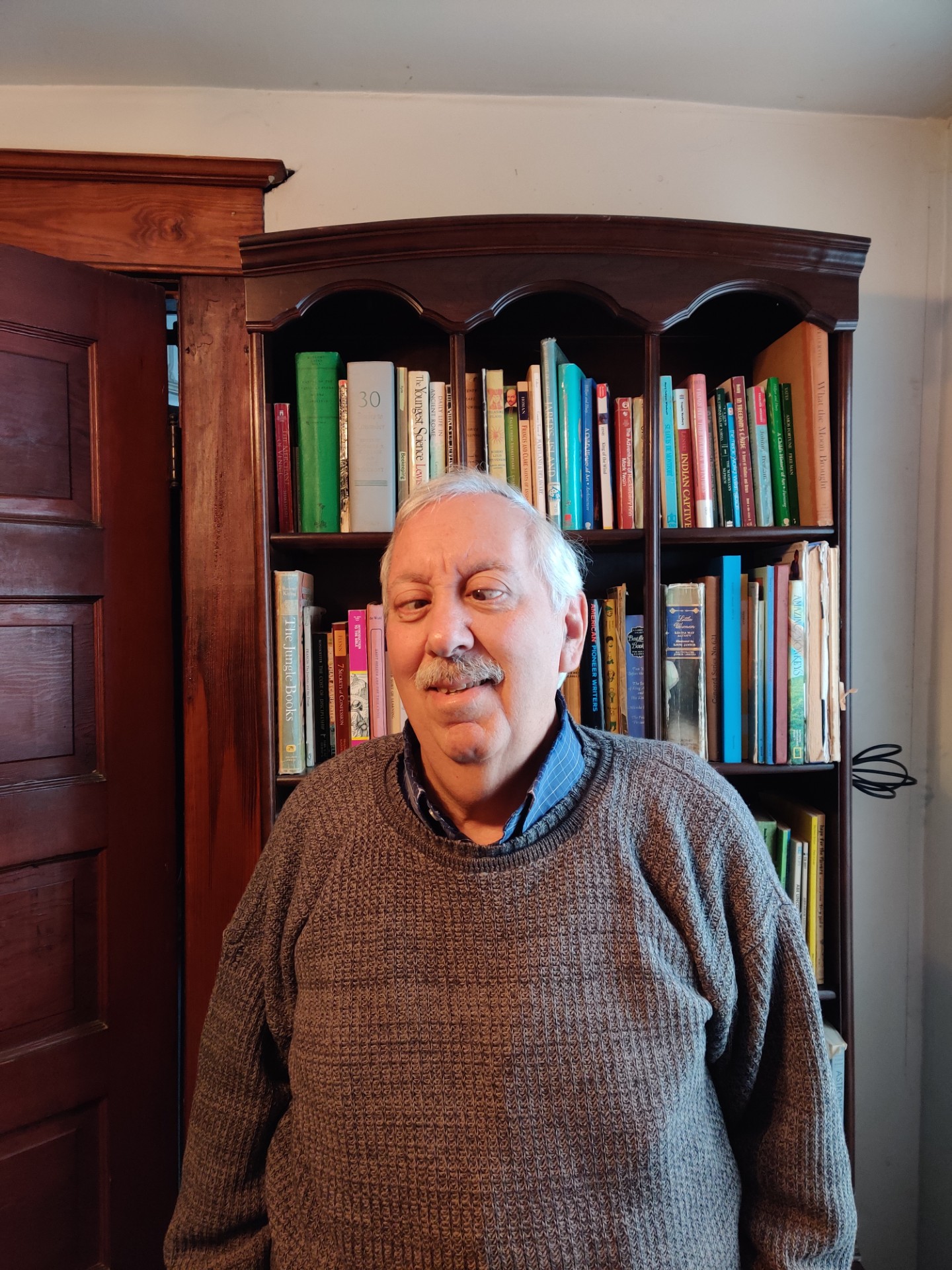
Board Member Spotlight: Alfred T. D’Agostino, Secretary
When Alfred D’Agostino was 12 years old, he found a book. It had belonged to an uncle who died before he was born. It was a volume called Chemistry and Modern Life, sitting on a shelf in his family’s New York City home. His uncle’s signature was inscribed on the front panel, dated 1926.
“I was so impressed with the figures and the photographs, the equations,” he said. “I actually took a fountain pen and put my signature in the front panel with the date 1965.”
From there, he said, he “proceeded to manifest other odd behaviors.” He read the book through sixth grade. He went to the library and copied things out of chemistry texts. He got a degree in chemistry, fell in love with teaching in graduate school, and never looked back. Since then he has built a career as a Professor of Chemistry that has spanned nearly five decades.
Born with a visual impairment, D’Agostino participated in New York City’s sight conservation program as a child, and his vision improved enough through adolescence that he drove a car and moved through college and graduate school largely without accommodation. He lost his vision gradually in adulthood.
In the lab, he adapted. Screen access software. Voice-enabled tools. Apps to identify colors and objects. A rigorous organizational approach. Physical familiarity with equipment he trusted.
“By the point I had to worry about safety, I knew what I could and could not handle,” he said.
“People present this almost legalistic argument: you present a danger to yourself and others,” he said. “That drives me crazy. It’s an attitude that employers — not only academic employers — use to exclude blind people from doing certain things.”
His answer has never been argument. It has been presence. He walks into the lecture hall with his cane. He boots up JAWS, runs his PowerPoint, and teaches.
“My first question on the first day is: does anybody know what this is?” he said, of the cane. “There’s dead silence, and then somebody will eventually say, ‘It means you’re blind.’ And I say, ‘Yes, I am.'”
“I’m sure it gives people concern. But I think I’ve changed my colleagues’ minds completely about what it means to be blind and doing chemistry.”
Around 2018, D’Agostino shifted his research focus from the experimental lab toward something he felt was more pressing: making sure the next generation of blind students didn’t face the same walls he had. He began organizing symposia for the American Chemical Society, publishing in the Journal of Chemical Education, and taking his work directly to blind students. At NFB training centers in Louisiana and Colorado, he arranged access to real university labs and brought students in for hands-on sessions. He did the same at BISM, working with about 16 middle school students from the GLIDE program.
“Real glassware, real chemistry,” he said. “I had everything set up.”
In January 2026, the Royal Society of Chemistry published Inclusive and Accessible Chemistry for Further and Higher Education, and D’Agostino’s chapter, “New Vision for the Blind in the Chemical Sciences”, anchors it. Thirty pages, over 100 references, covering the barriers BLV students face and the practical steps institutions can take to remove them.
“I actually had somebody from Austria email me asking for advice about how to work with their blind students,” he said. “I’ve gotten international response. I’m ever pleased with that.”
D’Agostino came to BISM as a student, taking a sabbatical from his faculty position to complete the year-long residential Core Program. He became a fixture in the building, arriving early and working at a table in the library before programming began. That’s how Tom Kohn found him and eventually asked him to join the board. He is now in his second full term and serves as Secretary.
He said what keeps him here is hard to articulate, but it has something to do with the feeling in the room.
“If you sit at the graduation ceremony for the Core Program and hear these amazing stories,” he said, “and you’re in close daily contact with the staff and the people in the program, it’s real. Nobody stands still. It’s always: let’s try this, let’s try that, let’s expand.”
“Advocacy and education,” he said. “That’s big for me at this point.”