

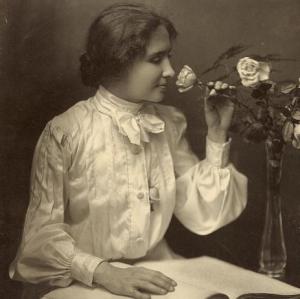
Helen Keller has long been the poster child for DeafBlindness. And yet somehow, in the cultural retelling, her legacy has shrunk from that of a prolific author and co-founder of the ACLU into the subject of a TikTok conspiracy theory.
In 2020 videos began circulating claiming that she was a fraud. That she and Anne Sullivan pulled the wool over our collective eyes by pretending that she was deaf and blind. The evidence being that a DeafBlind woman simply couldn’t have accomplished all that she had in her lifetime. Some go as far as to say she was not even real. That she is a complete and total historical fiction.
These conspiracies aren’t fringe either. The original video garnered over 600,000 views, and subsequent ones have amassed millions.
While many of these videos use controversy as a tool to drum up views, some are seemingly genuine.
Misinformation about DeafBlind people are harmful not just to the legacies of historical figures but to living, breathing, accomplished DeafBlind people navigating a world that has already decided what they can do.
So, in honor of DeafBlind Awareness Month, this article will answer your burning questions about Helen and DeafBlindness, in hopes that education really can combat ableism.
Was she even real?
Yes. Unambiguously, Unequivocally yes.
Helen Adams Keller was born June 27, 1880, in Tuscumbia, Alabama. At nineteen months old she contracted an illness, likely meningitis or scarlet fever, that left her both blind and deaf. She died on June 1, 1968, at eighty-seven, at her home in Connecticut. There are photographs. There is archived correspondence. There are decades of newspaper articles. There is a film of her speaking. She was friends with Mark Twain and Alexander Graham Bell. She met multiple sitting U.S. presidents.
In between birth and death, she earned a Bachelor of Arts from Radcliffe College and was the first DeafBlind person in American history to do so. She wrote fourteen books and hundreds of speeches and essays. She co-founded the American Civil Liberties Union in 1920. She marched in the 1913 Women’s Suffrage Procession in Washington. She supported the NAACP. She toured military hospitals during World War II to visit blinded soldiers. She received the Presidential Medal of Freedom in 1964. She traveled to more than thirty countries as a disability advocate. And she flew a plane over the Mediterranean Sea.
How did she learn to communicate?
Most people have heard the story of the water pump. On April 5, 1887, Anne Sullivan held Helen’s hand under the pump spout and spelled out “water,” and something clicked. What is often left out is that Keller was communicating long before Sullivan arrived. By age six she had developed more than sixty home signs that she used with her family. Sullivan gave her access to a shared language, which was essential and transformative, but Keller had been doing the work of communication her whole life.
This is what The Miracle Worker gets wrong. It positions Anne as Helen’s savior, and ends Helen’s story at a semi-manufactured eureka moment. Keller herself was openly exhausted by this. She wanted to talk about her politics, her writing, her opinions on war and labor, and women’s rights. What she got, in every interview for the rest of her life, was the pump. A story about Helen Keller that ends at seven is not a story about Helen Keller. It is a story about Anne Sullivan with a disabled child as the catalyst. When that becomes the version taught in schools, we shouldn’t be shocked when people don’t know enough about her to believe she was real.
How did she speak if she couldn’t hear?
Through a process called Tadoma. She placed her hands on a speaker’s face, touching the lips, jaw, throat, and nose simultaneously, to feel the physical vibrations and movements that produce speech. By learning how sounds are made in the body, she could learn to make them herself. She went on to give public lectures and radio addresses for decades.
It is also worth knowing that Alexander Graham Bell was one of the foremost champions of oralism — the educational philosophy that deaf people should communicate through speech and lip-reading, and that sign language should be actively suppressed. Disability rights scholars have since called oralism a form of oppression built on the premise that the only valid communication is communication that passes as hearing. Keller used manual sign language alongside speech for her entire life and never gave it up.
Was she actually smart?
During Keller’s lifetime, critics argued that her writing was too sophisticated to have come from a DeafBlind woman and must have been written by Sullivan or the men around her. This argument required no evidence. It required only the conviction that the quality of the work exceeded what a DeafBlind woman could produce. That conviction is still operational. It is what makes TikTok videos calling her a fraud feel like wit rather than what they are.
Keller wrote fourteen books and hundreds of essays and speeches on disability rights, labor rights, women’s suffrage, war, racial justice, and socialism. She held these positions at great personal cost. She joined the Socialist Party in 1909 when doing so was often life-threatening. She supported the NAACP to the explicit fury of her Southern family. She was a person whose positions made powerful people angry, which is a reliable indicator of someone doing their own thinking. The suggestion that Sullivan was secretly authoring her intellectual life is the same logic that has followed women’s work throughout history. The assumption that she cannot be the origin of her own thought is outright ableism.
Keller is far from the only DeafBlind person who built a significant life. She is just the only one most people can name, which is itself part of the problem. Laura Bridgman was mastering history, literature, mathematics, and philosophy at what is now the Perkins School for the Blind fifty years before Keller was born. Robert Smithdas earned the first master’s degree ever awarded to a DeafBlind person in 1953 and was named Poet of the Year by the Poetry Society of America. Haben Girma is a human rights lawyer, the first deafBlind graduate of Harvard Law School, and a WHO Commissioner of Social Connection. These are not exceptional anomalies.
How did she fly a plane?
In June 1946, Keller was traveling from Rome to Paris as a representative of the American Foundation for the Overseas Blind. As they crossed the Mediterranean Sea, the pilot handed her the controls. Her companion relayed the pilot’s instructions through hand communication, spelling them directly into Keller’s palm in real time. For twenty minutes, Keller flew the plane. The crew was reportedly astonished: her touch on the controls was calm and steady, no shaking, no overcorrection. Keller described it afterward as the greatest physical freedom she had ever experienced in her life.
Flight controls provide tactile feedback: pressure, resistance, the pull and response of the aircraft. Keller had spent her entire life learning to read exactly that kind of information with exceptional precision.
But could she actually see or hear anything?
The TikTok version of DeafBlindness, total silence, total darkness, complete sensory isolation, has become the default image. It is not accurate, and not just for Keller. She lost her sight and hearing at nineteen months, but retained other sensory capacities she spent her life developing. She navigated through vibration, touch, smell, and proprioception. She could identify people by the vibration of their footsteps.
Beyond Keller, DeafBlindness is not a binary. It refers to a combination of vision and hearing loss significant enough to affect communication, mobility, and access to information. Most people who are DeafBlind have some usable vision, some usable hearing, or both. Communication is adapted to each person’s specific abilities and needs. Methods include tactile sign language, tactile fingerspelling, print on palm, Braille, Tadoma, and a growing range of assistive technologies. There is no single method because there is no single experience.
So what?
There is a concept called priming: repeated exposure to an idea makes you more receptive to it, more likely to accept it as plausible without scrutinizing it. Every viral video that treats Helen Keller’s existence as a punchline primes its audience to find DeafBlind people’s capabilities a little less credible. That credibility gap does not stay online. It follows DeafBlind people into every room they enter.
The internet is right to be skeptical. Misinformation is everywhere and critical thinking matters. But there is a difference between skepticism and delegitimization. These videos are not questioning whether a historical claim can be verified. They are undermining the legacy of a DeafBlind woman and, by extension, DeafBlind people broadly. The punchline is that a DeafBlind person couldn’t possibly be that accomplished. That is ableism.
Helen Keller herself had to fight accusations of fraud and plagiarism during her lifetime. Someone without her level of privilege may not be admitted to college, may not be believed in a job interview, may not be accommodated in a workplace, because the people making those decisions have absorbed the idea — through jokes, conspiracies, and a general cultural assumption — that a DeafBlind person cannot possibly operate in the world.