

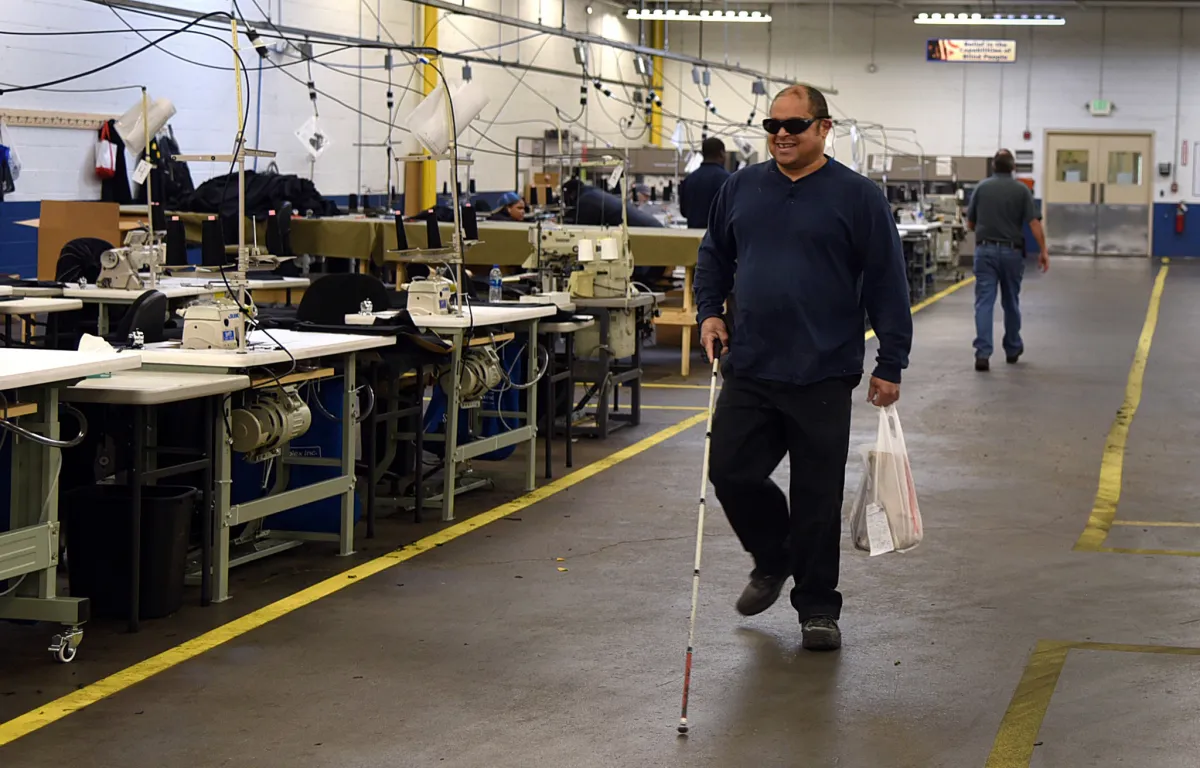
BISM President and CEO Mike Gosse published an op-ed in the Baltimore Sun on why nearly 70% of blind Americans remain unemployed or underemployed. He argues the barrier is assumption rather than ability, and lays out what employers can do about it: define the skills a role actually requires and drop the visual ones that have nothing to do with the work.
Read the article below, or click the link to read it in the Baltimore Sun: How We Can Improve Blind Employment Rates In Maryland
How We Can Improve Blind Employment Rates In Maryland
Walk through the doors of Blind Industries and Services of Maryland (BISM) on any given day, and you’ll witness something remarkable. You’ll see blind professionals manufacturing paper pads, cleaning chemicals, personal care kits, military jackets, along with another 700 products, as well as managing IT systems, handling accounting and HR and running sales operations — all the work that any complex business requires, and quite a bit that most businesses never attempt. Visitors who take our tours often reach the end and say the same thing: “That was amazing.” We believe the next thought should be just as natural: “I could use people like that in my company.”
BISM is the largest employer of blind individuals in Maryland, and while we’re proud of that work, we genuinely wish we didn’t have to hold that distinction. We’ve earned it because too few other employers have stepped up to hire blind professionals broadly across the wider workforce. Nearly 70% of blind individuals are unemployed or underemployed, a figure that has held steady for over 40 years. Each of us, blind and sighted alike, has the power to help unlock this untapped potential, and it begins when we stop assuming what blind people can and cannot do.
Every one of us arrives with a unique set of abilities, strengths that show up at different levels across countless skills. Blindness doesn’t erase those abilities; it simply creates a few new gaps. When someone becomes blind, they may no longer drive, but they can absolutely still get where they need to go. They may not see the printed page, but they can still read. At BISM, we help fill in those gaps with a powerful new set of skills. The result is a floor full of talented, capable professionals who prove every single day what’s possible.
The biggest barrier blind individuals face isn’t their own capability; it’s the assumptions made about it. When a disability is observable, people tend to draw quick conclusions before a person ever has the chance to demonstrate what they can do. As a blind person, I have experienced this firsthand. I once walked into a job interview holding a Ph.D. in electrical engineering, and the first question I was asked was how I would get to work without owning a car. That same pattern shows up across industries, in job descriptions padded with criteria that have nothing to do with the actual work, such as requiring a driver’s license for a role that doesn’t actually require driving.
This is where employers have a genuine and exciting role to play, and it starts with clarity. Define the core skills a job truly requires, and a far wider pool of talented candidates opens up. Take a fresh look at your workspace and notice where unnecessary visual requirements may have crept in. Often, accessible alternatives, such as a well-organized document management system in place of printed materials, make the entire organization run better, not just for blind employees, but for everyone.
Representation matters too. The blind individuals most visible in popular culture tend to be extraordinary exceptions — celebrated musicians and public figures whose achievements are framed as inspirational anomalies. What the world needs to see more of is blind professionals doing everyday work with skill and confidence. The more we showcase those ordinary moments of competence, the more we normalize the simple truth that a blind person thriving in their career is exactly what we should expect.
There’s also a deeply human part of this story. When someone first experiences blindness — whether they are a child born into a family with no prior experience of it, or an adult facing sudden vision loss — the information they encounter is too often rooted in fear rather than possibility. Connecting people quickly to the right training transforms that fear into capability. That’s the other half of BISM’s mission: equipping blind individuals with the full set of skills they need, so that a thriving community of talented professionals exists far beyond our four walls.
The 70% unemployment rate for blind individuals is not inevitable. It simply requires all of us to look past old assumptions and recognize the abilities that have been here all along. We need shared belief and collective will to carry these lessons into every workplace where a capable, trained blind professional is ready to make a difference. Let’s build a world that sees the ability first. I invite you to tour BISM’s facility, experience what happens here every day and let it reshape what you believe is possible.