

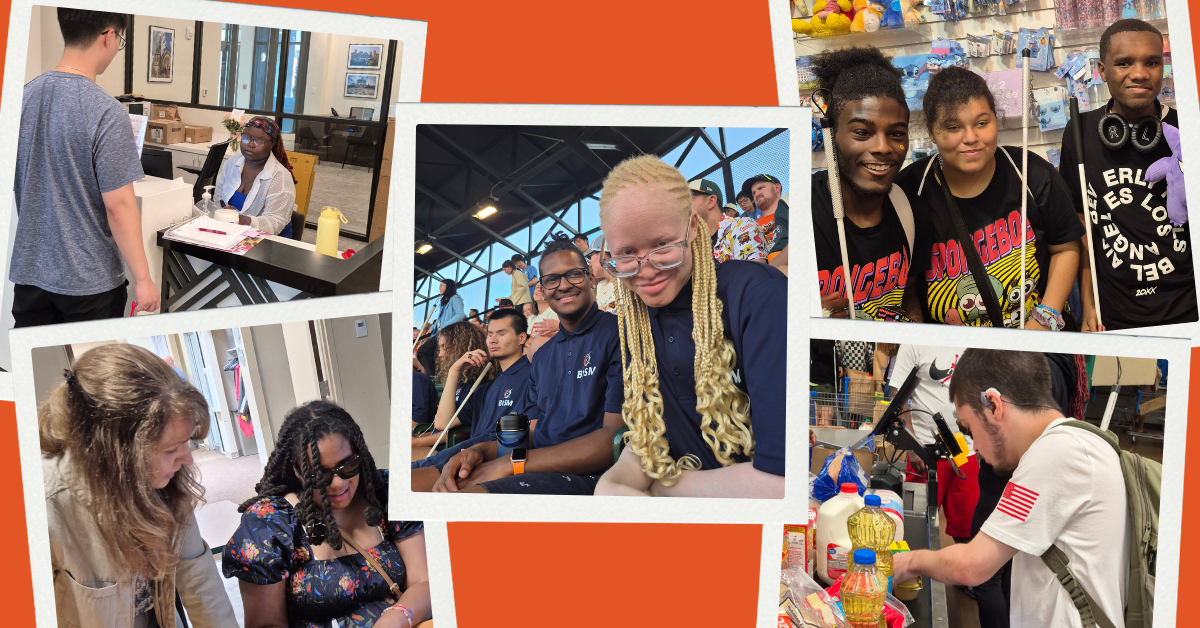
Every summer, a group of blind and low-vision teenagers move into apartment-style housing on a college campus. They learn how to grocery shop and cook for themselves for the first time, and clock in for real jobs across the region, proving, one placement at a time, that competence was never the question.
BISM’s Gold STAR program is a four-week, fully residential work-based learning experience for students ages 16 to 21. Participants live together while working part-time placements with local businesses, nonprofits, and government offices, pairing that hands-on experience with structured training in Braille, assistive technology, orientation and mobility, and independent living. It’s not just a summer job. It’s a dry run for adulthood. Students learn how to do the job and how to live independently while doing it.
Living It, Not Just Learning It
This year’s cohort trained out of UMBC, and independent living was as central to the summer as any work placement. Students planned meals, grocery shopped, and cooked for themselves, many for the first time without a parent or teacher managing the process. They learned to be good roommates, splitting chores and keeping shared spaces clean, and they even learned the difference between business casual and business professional.
Then there was the work itself. Placements were tailored to each student’s interests, matching students with employer partners including Habitat for Humanity, Modu-Tech, Can Access, and Baltimore County Councilman Pat Young’s office.
Two students, Aaron and Ebony, spent their placement in Councilman Young’s office working alongside his staff on legislative research. At one point in the summer, the two turned in a policy brief that Young says was so impressive he would’ve never guessed that two interns did it. “I remember reading it and thinking, this is genuinely good work,” he said. For Young, that moment was less about one strong brief than about what it proved: how quickly good work erases the low expectations that get set for blind youth before anyone even walks in the door. “If you’re not regularly engaged with a community, you need a reminder every so often of just how capable people are,” he said.
Graduation
At the end of the summer, employers, staff, students, and families gathered for a graduation celebration, a two-hour send-off where staff took turns sharing each student’s individual successes and handing out certificates of completion for a month of genuinely hard work.
What staff kept coming back to, over and over through the ceremony, wasn’t any single placement or project. It was the distance traveled: students who a month earlier had never lived away from home, never grocery shopped for themselves, never picked out a work outfit without someone else weighing in. One student had never even used a cane before arriving. By the end of the program, they were maneuvering through Habitat for Humanity’s entire store with ease, working the floor like they’d done it for years.