

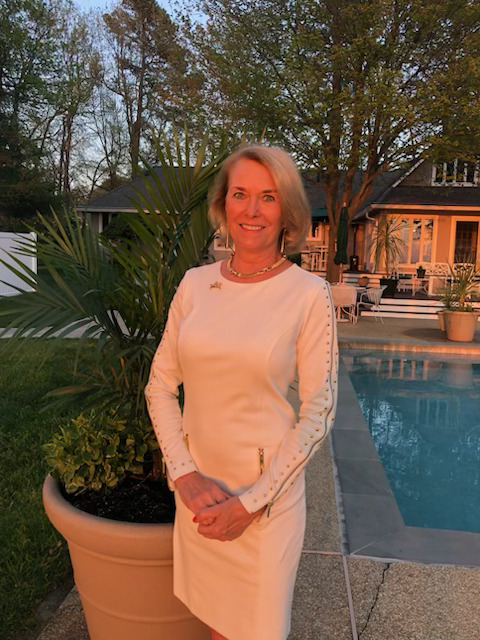
Anne Joyner’s career started at The Boy Scouts of America where she became the youngest paraprofessional in the coed Exploring program. It set the direction for everything that followed: a career spent almost entirely in fundraising, across the private sector, the public sector, and nonprofits.
Over the years, she started five different lecture series, including the New Jersey Forum, the Drew University Forum, the Maryland Forum, and the UMBC Forum, bringing in speakers like Henry Kissinger, former President George H.W. Bush, and Colin Powell. Each one doubled as a fundraiser for a cause tied to its host institution, and each one meant negotiating contracts, managing a thousand moving pieces, and being ready when something inevitably went wrong.
“The more that goes into the planning, the better you are when the catastrophe happens,” she said. “You can just manage that, as opposed to ten things going wrong.”
In 2012, Joyner combined that fundraising instinct with two lifelong loves: horses and disability work. She founded Talisman Therapeutic Riding on Maryland’s Eastern Shore, starting with one horse and one rider. The organization has since grown to twenty horses and more than fifty riders a week, serving children, adults, veterans, and first responders. In 2017, Talisman bought its own farm; this year, the mortgage was paid off.
Joyner has been riding for around 40 years and describes the specific kind of progress the horses make possible—a child on the autism spectrum saying their first word during a session, a veteran managing PTSD or an amputation by relearning trust and confidence through the discipline riding demands.
“What we know about soldiers is they do difficult work well,” she said. “When they’re done being a soldier, they still want to do difficult work.”
Joyner is also a rider without vision. She has retinitis pigmentosa, a degenerative eye condition, and has lost vision gradually over the past 30 years; she hasn’t driven a car in about 20 of them. She’s also spent eight years in a clinical trial at the Wilmer Eye Institute for a drug aimed at slowing the disease’s progression. She was one of the first 30 people enrolled; the trial now includes more than 500 participants worldwide.
Two years ago, her family encouraged her to build out some new skills, which brought her to BISM’s SAIL program in Salisbury. She graduated this past May.
“It is remarkable what the program can do to help you achieve independence,” she said, “from learning your phone and computer to cane skills to cooking without burning down the house.”
Braille, in particular, stuck with her. “I feel like I’m a codebreaker,” she said. What she remembers most about her time in the program, though, is the people. “The amount of patience the team has, the eagerness to help you figure things out, a good sense of humor. Their dedication is remarkable.”
Joining the board was not something Joyner set out to do. She was recommended for it and started with a brief ad hoc term before being asked to take on a full three-year term as trustee. “It was really quite an honor,” she said. Two years into BISM’s SAIL program had already shown her what the organization could do; the board gave her a way to keep building on it. She now serves on the program and development committees and is working with fellow trustee Sue Schaffer to grow the board itself, bringing in new members who can widen BISM’s reach.
That instinct, to make the circle bigger, is the same one that’s carried through her whole career: raise more money, get more people in the room, tell the organization’s story to whoever will listen. Judging by how fast she goes through business cards, there’s no sign of her slowing down.