

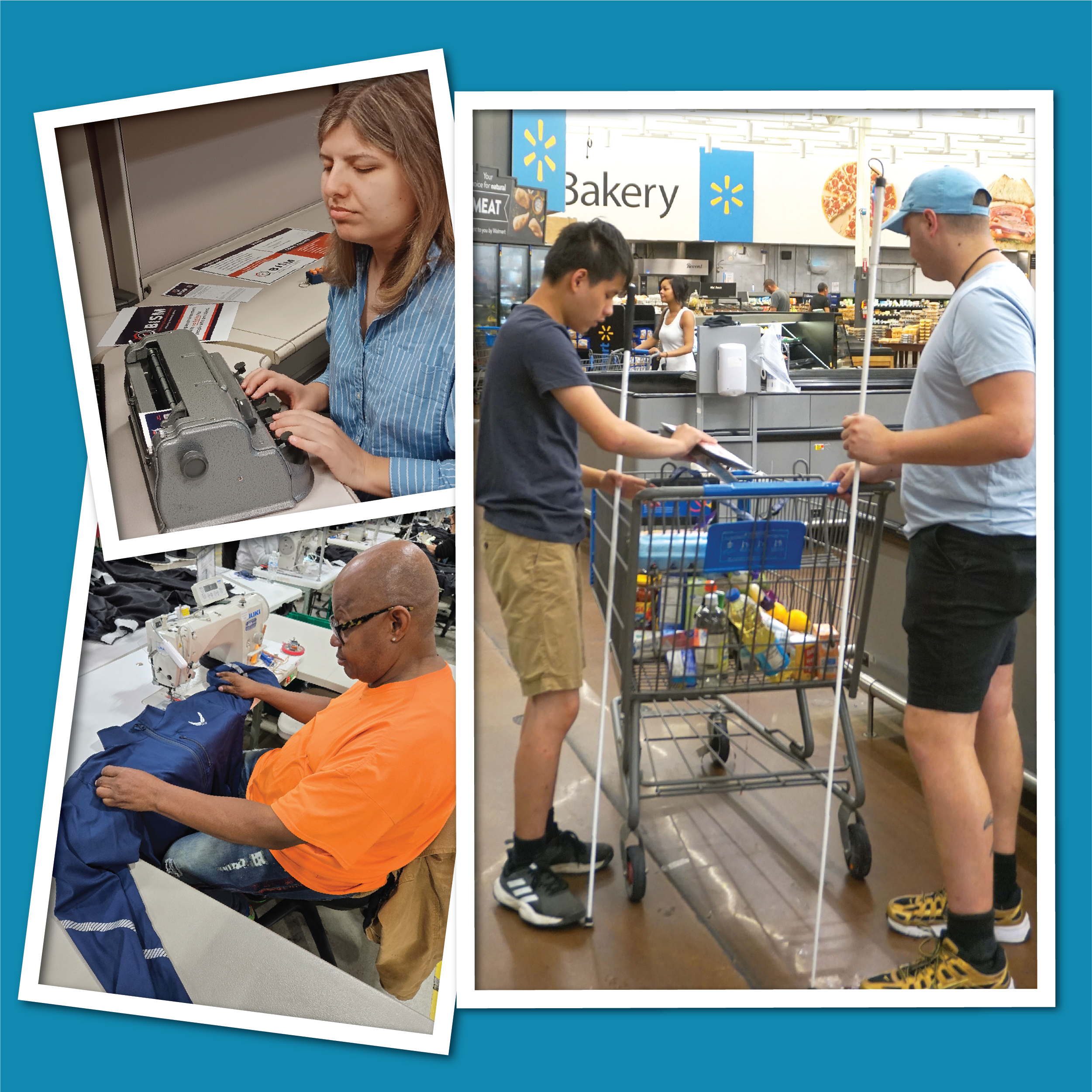
A look back at four decades of the Blind Industries and Services of Maryland’s Independence Training and Rehabilitation Program with Matt Yanuzzi, Director of ITR, and Andy McIver, Senior Director of Programs.
One of the first things Matt Yanuzzi, Director of ITR, did on Monday morning after a long weekend, was use his phone to DVR an Orioles game. It’s a small thing. The kind of task that barely registers in a sighted person’s morning routine. In fact, it’s so mundane at this point that it’s become obsolete for most. But Matt, who lost his sight in midlife, represents something he once thought was permanently out of reach: the ordinary rhythm of a day that belongs entirely to him.
As he puts it, the “bottom line” is simple: so much independence. That sentence — spare, almost offhand — is probably the best summary of what the Intensive Training and Rehabilitation program at Blind Industries and Services of Maryland has been building toward for the past 40 years.
ITR doesn’t teach people to cope with blindness. It teaches them that blindness, as a constraint on life, is a false narrative.
Ask Matt what has changed most about rehabilitation in the 40 years since ITR opened, and he doesn’t hesitate: the smartphone. Twenty years ago, he says, rehab didn’t have that tool — now you have information in your hands. And, he adds, nothing is more remarkable than what the world would call a blind stick: a straight white cane in its most simple form.
It’s a striking image: the oldest tool in the blind traveler’s kit alongside the newest, working together.
The cane empowers you to go where you want, when you want, and how you want. The phone tells you what’s there when you arrive. Neither one replaces the non-visual skills that ITR has always taught. Both of them extend the reach of those skills further than anyone could have imagined.
That interplay between tools and mindset leads directly into one of the program’s core ideas. Matt often says that getting lost is the best way to learn, and that philosophy — embracing disorientation as instruction — runs through everything ITR does. It’s more than a quip about orientation and mobility; it describes the emotional arc that most students travel. Matt is candid about his own: after losing his sight in midlife, he didn’t want to leave the house or talk to anyone.
Going blind is a sheltering experience.
One of the things Andy McIver, Senior Director of Programs, talks about most, when he describes what makes ITR distinct from other blindness training centers, is the degree to which the program bends toward the individual rather than asking the individual to bend toward the program.
That flexibility becomes especially clear in moments of crisis. Andy tells a story about a woman who arrived in the middle of a custody dispute, with her husband’s lawyers arguing that her blindness made her unfit to care for her children. ITR’s response was extensive. The staff mapped her entire training around the goal of demonstrating independence to a skeptical family court. They had her preparing lunches and walking them up to her son’s school so teachers and administrators could see a capable, mobile, blind parent in action. On snow days, they arranged for her son to come to the training apartments. They constructed an entire curriculum around the slow accumulation of visible, documented competence.
Experiences like that also shaped how the program evolved. One of ITR’s more interesting developments has been the deliberate addition of what Andy calls the job readiness component — a layer that sits on top of the core non-visual skills training that the program’s state grant is funded to provide.
The reason it exists is a little counterintuitive. Around six or seven months of training, students who were making strong progress would start to stall. They’d achieved real independence, and that success brought a new kind of fear: what’s next.
The job readiness component reoriented the arc of the program. From day one, students are filling out applications, going on job shadows, and doing mock interviews. The goal isn’t just to graduate from ITR; it’s to graduate to something specific.
Think of it, Andy suggests, like a bicycle wheel: job readiness at the hub, with every other class, travel, technology, cooking, as a spoke running outward from it.
Seen over time, those changes add up. Andy has been part of ITR long enough to have watched students become instructors, instructors become administrators, and administrators become the kind of board members who show up to meetings because they genuinely can’t stay away. He’s seen the program shrink and grow and shrink again and grow again. He has, by his own account, managed staff through a pandemic with a Scooby-Doo van meme on his wall as his primary motivational infrastructure. He is not, in other words, someone who traffics in easy optimism.
Which is why it means something when he says the next chapter excites him. New certifications are coming. The partnership with the National Federation of the Blind is deepening. The board is stacked with people who didn’t just believe in what ITR does — they lived it. The residential program is eyeing expansion. And the job readiness model that took years to build is now the backbone of how every student moves through training from day one.
For Matt, that long view is personal. He writes the board reports and reads them back at the end of each month, and every time, he says, the work still surprises him — not because it’s unfamiliar, but because it accumulates. Student by student. Skill by skill.