

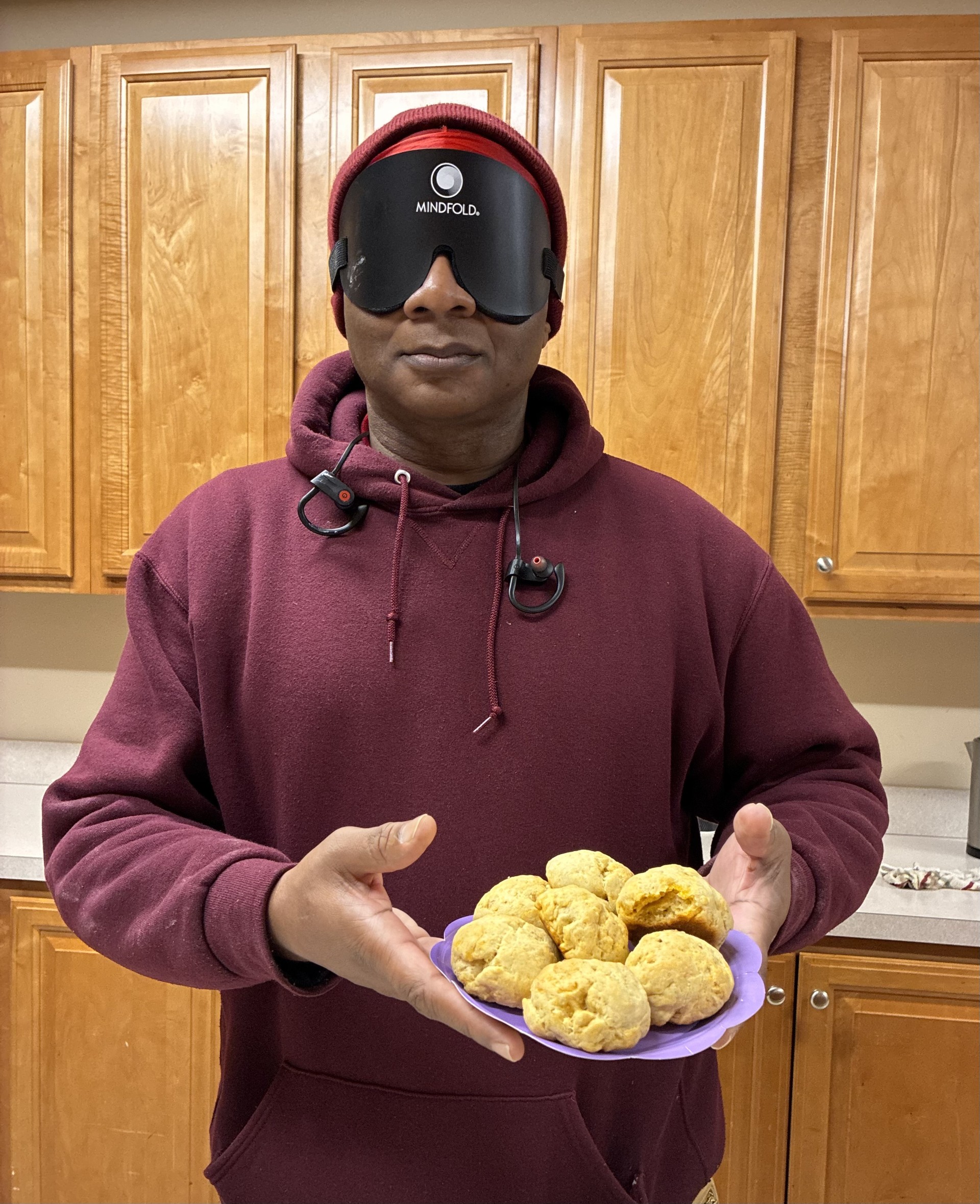
A series of non-visual, sensory descriptions of BISM’s Seniors Achieving Independent Living (SAIL) students making cheddar garlic biscuits from scratch.
Morning gathers in the kitchen not with light, but with sound.
A cane sketches the doorway first — tap, pause, tap — bright as a metronome on tile, then softened to a swallowed hush as it crosses onto carpet. The room opens through echo and absence. Space is measured in reverberation.
A cabinet exhales. Glass trembles inside — a delicate chiming, like bells nudged by a breeze. Fingers follow the music and find the rim of a bowl. Ceramic answers with a low, satisfying clink.
Students rifle through drawers in search of plastic measuring cups. The search is guided by texture. Success feels like smooth circles set together, but it also sounds like it: a hollow knock as the right size cup meets the counter.
The measuring cup dips into the flour and emerges. The flour falls into the bowl with a padded hush, like fresh snow landing on snow. Another scoop. The sound deepens from whisper to weight. One student pauses, listening to how full the bowl sounds when the flour hits; shallow at first, then more muted as the pile rises.
A jar is lifted and shaken.
Garlic powder slips out in a thin, silvery stream. The jar beside it speaks differently. Dried herbs tumble in uneven bursts, papery and bold, a crisp rattle.
Powder sighs. Leaves clatter. The difference is unmistakable.
Some spices are less distinct. The difference between salt and pepper can only be determined by smell or taste. Salt is clean and crispy, while pepper is spicier and woody.
Salt patters in.
A fingertip traces the rim of the bowl, circles once. The plastic of the measuring cup bangs against the recently found rim three times: clink, clink, clink. As the remaining flour falls out of the cup the sound becomes hollow once again.
Water starts as a furious rush in the pipes, then spills into the measuring cup with a lively gurgle. Fingers slide into the side of the cup, feeling the temperature, gauging the rising level. When the water nears the lip, the pitch changes. It becomes deeper and fuller. Poured into the bowl, it lands with a rounded glug.
Milk follows — silkier, softer — a low pour that folds into flour.
Butter waits in a pan.
The stove answers with a muted click and a bloom of heat. Butter meets metal in silence, then begins to speak. A shy fizz. A gentle ticking. When it rises to a steady gurgle, it is ready.
Back at the bowl, hands enter.
Dough presses back, cool and pliant. Palms fold it over itself. There is a tender thud as it meets the counter, a rhythmic press and turn, press and turn. The counter carries the vibration outward. Fingers read the dough’s texture like Braille. Too sticky, and it clings. Too dry, and it crumbles.
Parchment paper is unfolded with a brittle rustle, stiff as winter grass. Each dough ball lands with a muted pat, spaced by wandering fingers measuring the whole of the pan, finding the middle, placing the dough down then repeating the process until the pan is covered.
Across the room, microwave buttons produce clicks beneath confidently placed fingers, the raised bumps on the numbers are small constellations in the dark. The machine hums to life, a low electric drone that settles into the background.
Siri is put to work:
“Set timer, 11 minutes.”
“Adjust 11 minutes.”
“Adjust 12 minu—”
“Set timer.”
Technology becomes another sense as auditory confirmation replaces a standard clock.
In the oven, heat gathers. The door seals with a padded thump. Inside, something begins to happen. It can be heard in faint shifts — a soft expansion, a subtle crackle as edges firm and tops rise.
Waiting has its own sounds: breath, fabric shifting, the light brush of a hand clearing flour from a counter with a long swish. The towel moves in broad arcs, whipping across the surface.
When the oven finally opens, heat rushes out in a warm exhale. A tray slides forward with a careful scrape. The biscuits settle as they cool. Hands hover first, feeling for heat. Then fingertips press gently at the edges. Gooey means back in the oven. Firm with a slight spring means they’re ready. One biscuit is broken open.
Too much baking powder.
The realization arrives not in sight, but in taste. They are sharp and metallic. Laughter erupts. The remaining batter meets the trash can with a large comic splat.
“Better to learn now,” someone says, still laughing.
Flour sighs once more. Water gurgles. Herbs rattle. Butter applauds.
The students make the second batch with surer rhythm. Stir. Fold. Press. Turn. The dough answers willingly now, elastic and cooperative beneath steady hands.
Independence does not arrive all at once. It is built in taps and blinks, in missteps and second batches, in the steady rhythm of those that are learning how to listen. And, when it is finished, it sounds like:
The sharp report of a cane mapping the floor.
chiming in cabinets.
Garlic whispering.
Herbs clattering.
Butter crackling its fire.
Dough thudding in patient rhythm.
Oven timers dinging, and
The satisfying thunk of a well made biscuit.