

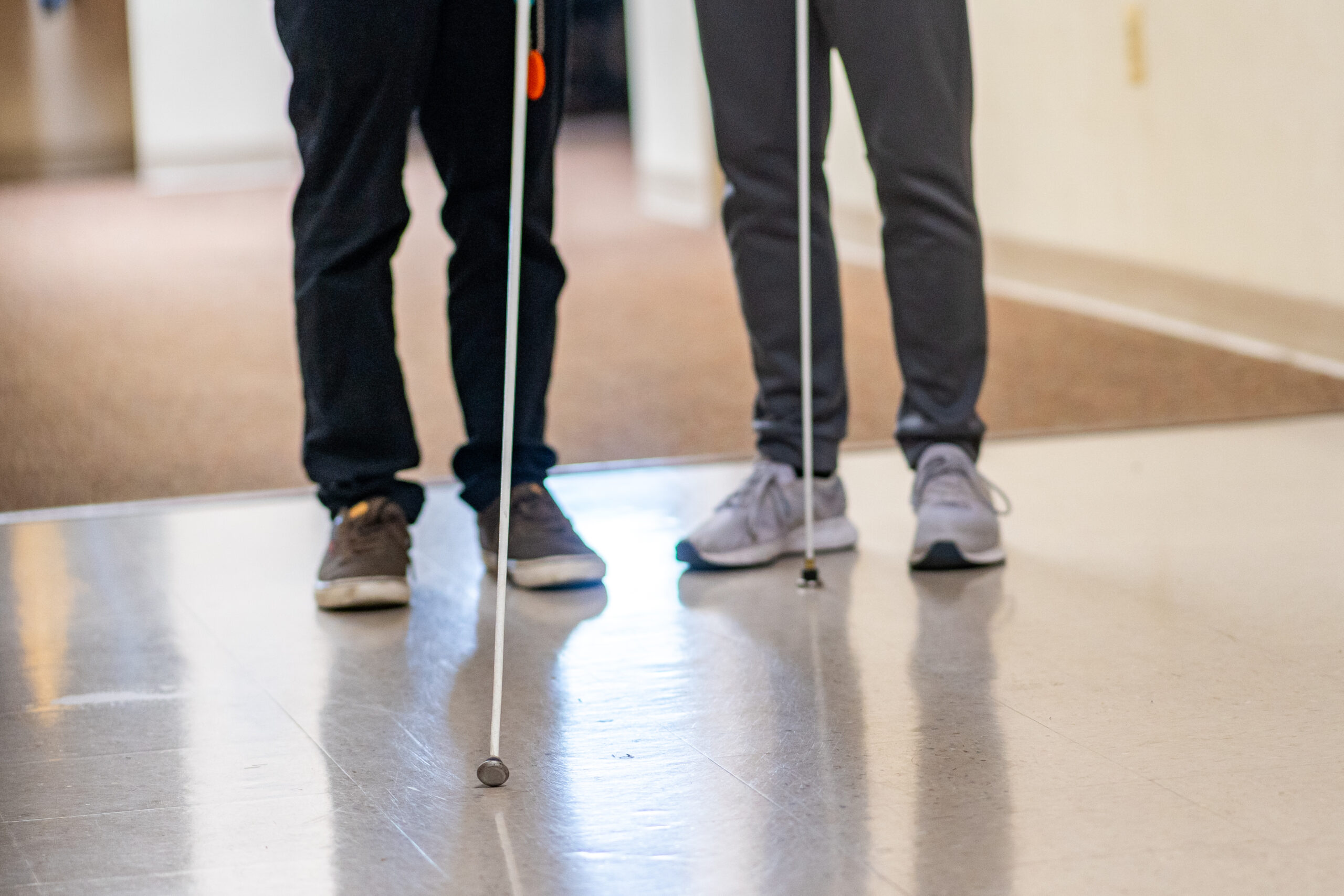
In recognition of White Cane Safety Day
We are in an age of unprecedented technological innovation. It feels like every time you blink, a new piece of technology is introduced that claims to revolutionize some aspect of modern life. And much of that tech has been revolutionary, especially when it comes to getting around. GPS means no one has to memorize a route or unfold a map to get somewhere new, and with rideshare apps a car is just a tap away.
These innovations are monumental for blind and low vision individuals.. Self-driving car companies are reducing incidences of people with service dogs getting turned away from an Uber. Smart glasses can read text aloud and describe what’s in front of you, and they can connect you to a Be My Eyes volunteer with a single voice command.
While many of these inventions have a justifiable allure, it’s important not to let tech replace the fundamental skills of independence. What happens when the battery on your smart glasses dies in the supermarket? What about people who can’t afford a Waymo to get across town? That’s why, even with all of this new travel technology, BISM focuses first and foremost on skills that guarantee independence in every situation.
None of this is to say you shouldn’t use the technology available to you. In fact, at BISM we teach entire classes on assistive technology, including how to use VoiceOver, JAWS, NVDA, and your phone in daily life. We’re also partnering with Meta to help distribute free AI smart glasses to blind veterans. Technology Is transformative. It just shouldn’t replace your orientation and mobility skills.
Why Travel Tech Can’t Be the Whole Plan
Travel-based technology and travel skills do different jobs. Smart glasses and apps are good at describing the world. They tell you what a sign says, what’s on a shelf, what a storefront is called. A cane, paired with solid orientation and mobility training, is how you move through the world. It tells you where the curb drops, where the stairs begin, and where the sidewalk ends.
Sure, you could theoretically do that with smart glasses or an app, but that has its own issues. What does “right in front of you” mean? Is it centimeters away? Inches? Your cane is an extension of your body that gives you physical feedback on what the world around you feels like. It stands in for your depth perception more than anything, and AI and cameras haven’t yet figured out how to translate the 3D world into that kind of physical feedback. Navigation apps run into a similar problem. GPS-enabled smartphones are typically accurate to within about 16 feet under open sky, and accuracy gets worse near buildings, bridges, and trees, which describes plenty of city blocks.
Your cane does it all instantly, with no battery, no data plan, and no subscription.
Batteries die. Popular smart glasses list battery life of about four to eight hours depending on the model, which is less than a full day of work, errands, and getting home. Signals drop, apps update and break, and AI descriptions can misread what’s in front of them. That’s why AFB’s AccessWorld cautions that smart glasses aren’t a replacement for a cane and aren’t fast or accurate enough for something like crossing a street. A mistake there isn’t an inconvenience.
Then there’s cost. Popular smart glasses start at $299 and can run up to $379 depending on style and lenses, and they require a compatible smartphone and an account to work. Add rideshare fares and data plans, and the price tag grows. Access to tech is also unequal to begin with. Pew Research found that adults with disabilities are less likely to own a smartphone (72% vs. 88%) or a computer (62% vs. 81%) than adults without disabilities, and a smartphone is the gateway to most travel apps. A cane and the skills to use it don’t come with a monthly bill.
Even If the Tech Were Perfect
Say the tech never failed, never misread anything, and cost nothing. Baseline travel skills would still matter.
Travel skills are about more than avoiding obstacles. They’re about knowing where you are, building a mental map of a space, and making decisions about how to get where you’re going. Those skills are what lets someone take a job across town, run errands on their own schedule, or say yes to a spontaneous dinner without arranging a ride first. Researchers at the National Research & Training Center on Blindness and Low Vision found that confidence in transportation skills is linked to employment outcomes for blind and low vision adults who don’t drive.
It’s also just a better way to live. Most of us would rather not follow a recipe every time we cook, or need a GPS to know which way home is in our own neighborhood. We use those tools when they help, and we’re not worried when we don’t have them. Tech can be a powerful layer on top of that foundation. It just can’t be the foundation.
More Than a Tool: The White Cane as Identifier
White canes don’t just function as a tool, they’re also a powerful identifier. A white cane tells drivers and pedestrians what to expect and gives its user the right of way. In fact, the original white cane wasn’t a navigation tool at all.
In 1921 James Biggs, a photographer in Bristol, England, lost his sight in an accident. Worried about the growing traffic around his home, he painted his walking stick white so drivers would notice him. In 1931, Guilly d’Herbemont launched a national “white stick” movement in France, donating thousands of canes.
By the early 1960s, the National Federation of the Blind had asked the nation’s governors to proclaim October 15 as White Cane Safety Day. On October 6, 1964, Congress passed a joint resolution authorizing the president to do the same, and President Lyndon B. Johnson issued the first proclamation within hours. His proclamation described the white cane as a symbol of a blind person’s ability to “come and go on his own.”
The day has grown beyond its original focus on driver safety. In 2011, President Barack Obama also proclaimed October 15 Blind Americans Equality Day, shifting attention toward blind Americans’ full social and economic integration. The cane is a safety signal, but it’s also a symbol of independence and equality.
Why BISM Values the Cane
This is why the white cane is central to our work at BISM. Since 1986, our Independence Training and Rehabilitation (ITR) division has offered training in four crucial areas: braille, technology, home management, and travel. In travel, students learn to use the long white cane to get around confidently in their communities and beyond, including crossing busy streets, riding public transportation, navigating crowds, and using environmental cues to orient themselves in familiar and unfamiliar places. Our instructors, most of whom are blind themselves, teach nonvisual skills they use every day. Travel training is part of every program we offer.
This year, we’re marking White Cane Safety Day with a white cane safety walk at our BISM Baltimore campus, joined by community partners and BISM associates. Our associates will demonstrate their travel skills, our instructors will showcase the training they teach, and we’ll be sharing information on why the white cane matters and how to interact respectfully with cane users.
To learn more about our training programs, visit our programs page, or schedule a tour.