

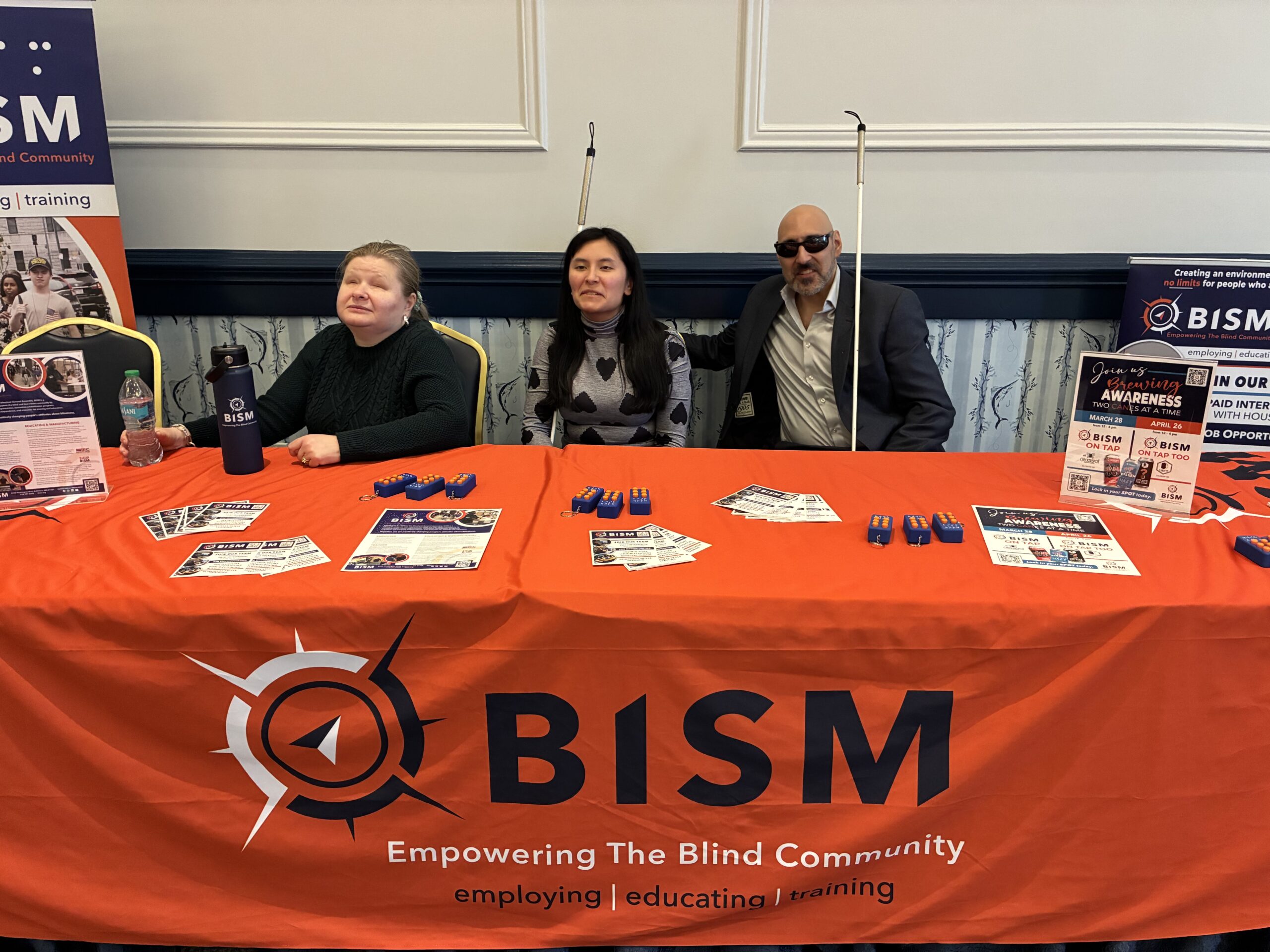
This weekend, I was lucky enough to attend the National Federation of the Blind of Maryland (NFBMD) conference. As a first-timer, my goal was simple: take it all in. Attend as many panels as I could, jump into discussions, maybe snap a few pictures, and, if all went well, turn it into a blog post.
Knowing I wanted to share the experience with our online audience, I spent a lot of time thinking about how to make this worthwhile for someone who wasn’t there. There were plenty of moments that show the culture of the conference but don’t translate well in a retelling—like the audience using every kind of obnoxious noisemaker imaginable to applaud speakers, or the flurry of bids on a small bag of homemade chocolate rum balls.
And then there were moments I immediately knew I had to include.
First, NFBMD President Ronza Othman’s speech about flying a plane. Not only is she an incredibly eloquent speaker, but more than that, her story embodies the NFB philosophy perfectly. Most speeches about blindness tend to fall into one of two categories: someone talks about how they accomplished something in spite of their blindness, or how they did it because of it. Ronza’s story was different. Flying a plane is impressive no matter who you are. Her story showed that blind people can do extraordinary things not in spite of or because of their blindness, but because they are people and people can do extraordinary things.
The exhibit hall was fascinating, too, because it tied perfectly into the legislative goals of the weekend. I spoke with a representative from Waymo, the self-driving car company, who was genuinely excited about the potential for this technology to give blind people independence without relying on taxis or public transit. Hours later, I heard that the NFB is working on removing outdated license requirements for those same self-driving cars.
But none of those were my favorite part of the weekend.
My favorite moment happened Friday night, crammed into an Uber with five other blind people on our way to grab food after a long day. It was loud, a little chaotic, and deeply unremarkable in the best possible way.
Knees bumped. Canes wedged awkwardly between seats. We rehashed the day’s events, laughed, complained freely. Those of us with sight read menus aloud. The person best with a screen reader efficiently ordered the Uber back while I grabbed the check. It was coordination, efficiency, and joy all wrapped into one small moment. VoiceOver announcements cut into conversations mid-sentence. And for once, none of it felt like something that needed explanation.
That was the point.
Throughout the conference, panels and programming were engaging, but they weren’t the center of gravity. The president’s speech about flying a plane wasn’t framed as spectacle, and the tech panel wasn’t a sales pitch (most of the time). They were part of a larger ecosystem of blind people exchanging ideas, without translating their experiences for a sighted audience.
Even the logistics reflected this. Marshals stood outside rooms calling out numbers so people could orient themselves. Groups of cane users naturally formed “trains” down hallways, following one another’s pace to avoid collisions and wrong turns. None of it was announced or planned beforehand, it just worked, because it was designed by people who needed it.
What kept drawing me away from the “big moments” were the small, social ones. Meals. Side conversations. Shared annoyance. Shared excitement. The luxury of not being the only blind person in the room.
Being around people who instinctively understand your experience creates a rare kind of rest. Not physical rest, but social rest. You don’t have to explain yourself, justify your access needs, or soften your frustration for anyone else. You can just exist, and the space functions around you.
That’s also why spaces like Blind Industries and Services of Maryland (BISM) are so important. By employing blind people and training them through other blind professionals, BISM recreates this same dynamic in everyday work life.
By the end of the conference, I realized something important: my favorite part wasn’t something I could have planned to notice. It wasn’t on the schedule. It happened in cars, restaurants, side conversations, late at night, between people who didn’t need footnotes for their lives. It was the feeling of being in a space where white canes, screen readers, and shared frustration were so standard that I stopped seeing them as remarkable.
That kind of space is rare. And once you’ve been in it you understand exactly why people keep trying to build it again and again.